Hold This Bit Here:
a field guide to being useful
On soldering, restringing, bending silver at midnight, and the surprisingly important role of the family dogs in quality control.
There is a phrase in this house that functions less as a request and more as a stage direction. It arrives quietly, mid-sentence, without preamble:
“Can you just hold this bit here.”
Not a question. The inflection has long since been removed. It is simply a statement of what is about to happen to you.
You put down whatever you were doing. You cross the workshop. You are shown a piece of silver – or a strand of pearls, or a section of chain, or occasionally something so small you have to be told twice where it is – and you hold it. Precisely. Without moving. Without breathing too enthusiastically. For as long as is required.
“How long?” you might ask, the first time. You will not ask again.
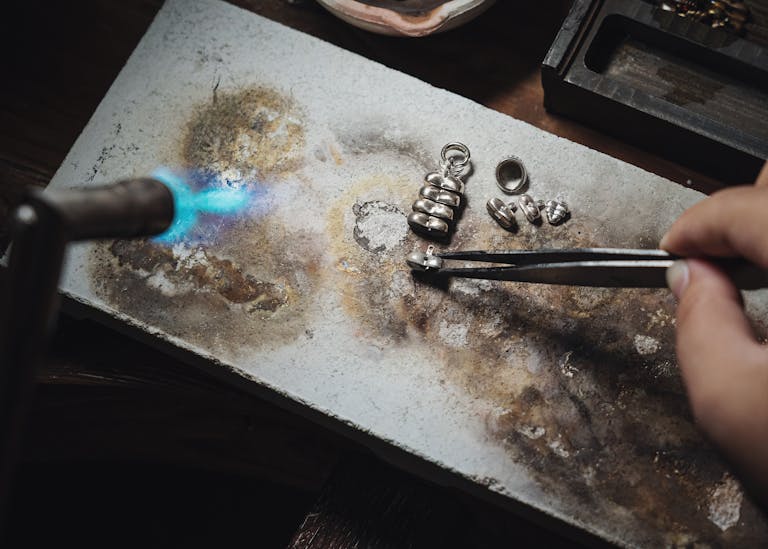
The honest answer, I have come to understand, is: until it’s done. And “it” could mean a solder join on a silver commission that needs a third hand to keep the pieces aligned while the torch does its work. It could mean a section of a larger piece being coaxed into shape – silver being bent, slowly and deliberately, while I provide the counter-pressure that stops the whole thing springing back. Or it could mean a necklace restringing, where my job is to keep the tension on one end of a silk thread while knots are worked between each pearl with the concentration of someone defusing something.
Scene: approx. 11.30pm, most evenings
The torch hisses. The lounge smells of warm metal. A silver commission – something bespoke, something someone has been waiting months for – is held in two pairs of hands. One pair knows exactly what it is doing. The other pair is mine. I have been told not to move. I am not moving. I am barely existing. On the mat behind me, a dog’s head rests heavily on the back of my ankle.
I should say something about the dogs at this point, because they are very much part of this operation, and they would be offended to be left out.
Quality control report
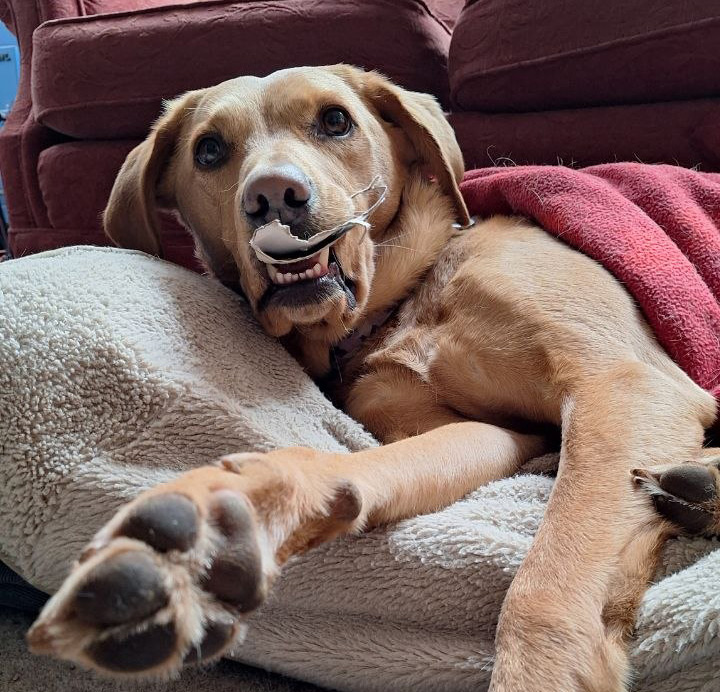
Both dogs are present for most late-night workshop sessions. Their role is observational. They arrive, locate a position from which the maximum amount of floor can be claimed, and watch. Whether they are assessing the quality of the work or simply waiting to see if anyone drops something remains unclear. Either way, their attendance is non-negotiable.
The back of a dog’s head, it turns out, is an excellent barometer of how a commission is going. If both dogs are settled and drowsy, things are progressing well. If one of them sits up and tilts their head – that particular look of alert, slightly baffled interest – it usually means something has slipped, shifted, or needs to be repositioned. They have not been wrong yet. I am not saying they are gifted. I am saying the correlation exists.
What I have learned, across many late evenings and a frankly unreasonable number of silver commissions, is that being useful in a workshop is a precise and underrated skill. It is not glamorous. There are no drawings involved – those come earlier, on the couch, when I sketch out the commission on my iPad so the client can see what they’re getting before anyone picks up a tool. That part I rather enjoy. The holding-still part requires a different set of virtues: patience, spatial awareness, and the ability to maintain a grip that is firm but not tense, steady but not rigid, helpful but entirely invisible to the finished piece.
The silver does not care that you are tired. The solder does not care that it is nearly midnight. The dog behind you does not care about any of this at all, but is warm and present and somehow, in the particular way of dogs, makes the whole thing feel less strange.
The piece gets finished. It always gets finished. And in the morning it will be beautiful, and no one will know I was there. Which is, I have decided, exactly as it should be.
*No silver was dropped during the making of this post. One dog did fall asleep on my foot. I did not move it.